 Skip to content
Optical splitters are widely used in the Industrial Internet of Things (IIoT), thanks to their ability to collect data from multiple points. They can distribute the main optical signal to multiple sensors and PLC nodes, replacing point-to-point wiring and saving over 70% of resources.
- 2xN series optical splitters can build self-healing ring networks (such as PROFINET MRP), with single-point failure switching time <50ms.
- 1xN series optical splitters transmit multi-node data through a single fiber, supporting TSN (Time-Sensitive Networking) for microsecond-level synchronization, meeting the needs of machine vision and motion control.
Due to the specific requirements of IIoT applications, there are strict demands for miniaturization, high stability, and wide temperature range adaptability. The following are typical application scenarios and splitting ratio selections, for reference only:
| Application Scenarios | Recommend splitting ratios | Fiber optic cable type | Transmission distance | Technical requirements |
| Factory sensor networks | 1×8 / 1×16 | OM3/OM4 | ≤300m | Low loss (≤0.5dB), vibration resistant |
| Power monitoring | 2×8 (redundant) | OS2 | ≤10km | Dual bus protection, IEC 61850 certified |
| Machine vision clusters | 1×4 / 1×8 | OM4 | ≤100m | High uniformity (≤0.3dB), low latency |
| Oil pipeline DTS (Distributed Temperature Sensing) | 1×2 95:5 | OS2 | ≥20km | High isolation (≥55dB), high temperature resistance |
IIoT Specific Packaging Types
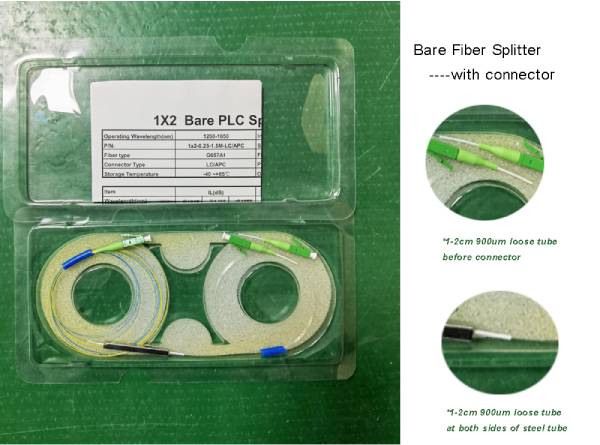
Bare Splitter Type
- Dimensions: 40*4*4mm
- Advantages: Direct fusion splicing or quick connector termination, suitable for embedded installation on equipment panels.
- IIoT Adaptability: Integrated with IP67 protective casing, resistant to oil and dust.
ABS PLC Splitter
- Dimension: 100*80*10mm or 90*20*10mm (with LC/SC ports)
- Advantages: Dustproof ports (with dust caps), supports plug-and-play, compatible with industrial switch optical modules.
- Example: Used in Siemens PROFINET ring networks to connect IO-Link masters.
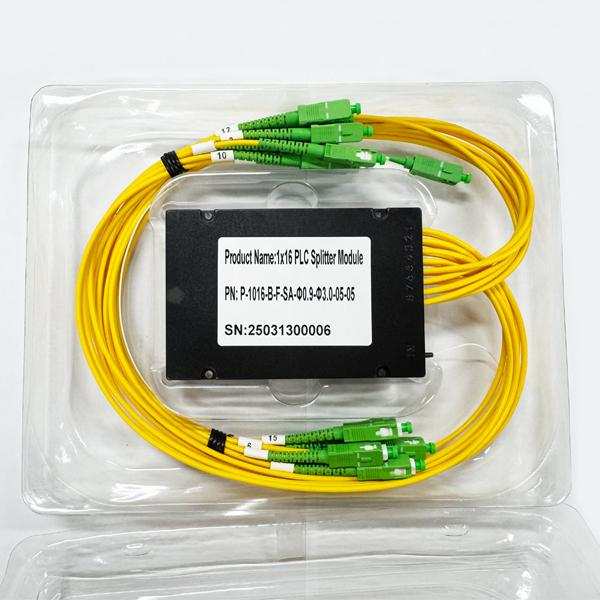

Industrial Rack Mount PLC Splitter
- Configuration: 19-inch 1U chassis, integrated with 12 x 1×8 splitters
- Function: Supports hot-swapping, real-time fiber optic link monitoring (e.g., ODN-i system)
- Applicable Scenarios: Main distribution rooms of large factories, substation communication rooms.
Stainless Steel Tube Splitter
- Structure: 304 stainless steel tube + silicone filling
- Protection Rating: IP68 (1 meter underwater/72 hours), pressure resistance ≥2000N
- Applicable Scenarios: Underground pipelines, port machinery, mining vehicles (vibration 5-2000Hz).

Other scenarios, such as high-temperature resistant ceramic packaging and explosion-proof packaging for special power dividers, can be customized according to customer requirements.
Further discussion if needed, please send inquiry to us, let’s talk.
Key Technical Requirements for IIoT Scenarios
In IIoT applications, we need to focus on the following parameters, whether in general or demanding industrial environments.
| Parameters | General Industrial Use | Harsh Industrial Environment | Test Standards |
| Operating temperature | -20℃~70℃ | -40℃~85℃ | IEC 61300-2-22 |
| Vibration resistance | 5G@200Hz | 20G@2000Hz | IEC 60068-2-64 |
| Protection class | IP54 (Dustproof and splashproof) | IP68 (Waterproof) | IEC 60529 |
| Insertion loss | ≤0.6dB (1×8) | ≤0.4dB (1×8) | GR-1209-CORE |
| Uniformity | ≤0.8dB | ≤0.3dB | Telcordia GR-1209 |
How to choose an optical splitter suitable for IIoT applications?
- Firstly, perform optic plc a scenario analysis.
For ordinary workshops, choose LGX PLC splitter or ABS PLC splitter. For environments with vibration, humidity, or high temperatures, choose armored or special encapsulated adapters.
- Secondly, select the appropriate plc optical splitter packaging method.
If use LGX cassette splitter or ABS PLC Splitter, which will decide either panel-mounted or rack-mounted wiring.
Panel-mounted options typically use LGX modules with IP65 or higher rated fiber optic box protection, where have a slot or bracket to hold the cassette splitter.
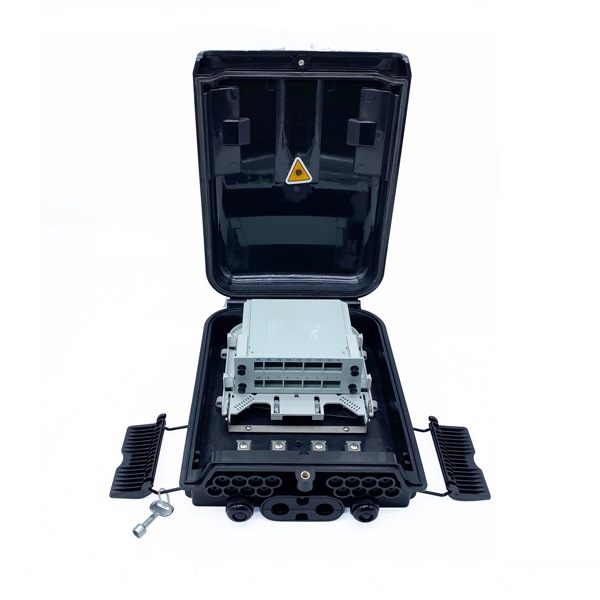
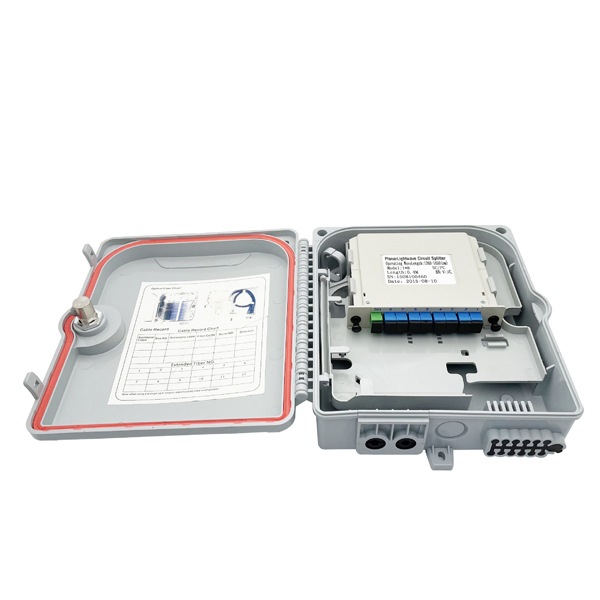
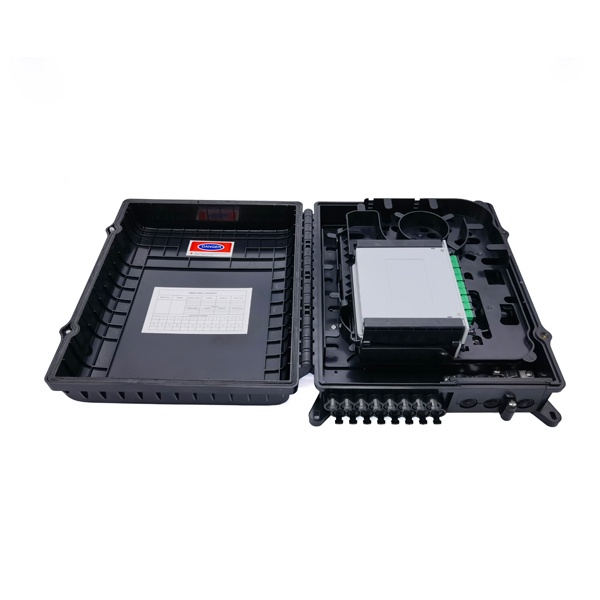
If used in a rack, an ABS PLC Splitter can be selected, which usually has corresponding module box slots.


- Finally, for other special environments, the customer needs to provide specific requirements, and our company will customize the packaging method according to the customer’s needs.
KIND NOTE:
- During installation, pay attention to the bending radius, which should be ≥30mm (static), ≥60mm (dynamic).
- Use cable ties and damping gel to secure the fiber in vibration-prone areas to avoid stress concentration.
- If there is a sudden increase in insertion loss (IL) in the fiber optic link, use an industrial endoscope to check for end-face contamination.
- If the signal is interrupted, verify that the splitting ratio is matched; for example, a low-power sensor requires a 95:5 splitting ratio. An incorrect splitting ratio can significantly affect signal transmission.
- Additionally, if the budget allows, consider integrating a smart splitter with an optical power monitoring port to monitor the link status in real time (such as the Huawei iODN solution).
Conclusion
In IIoT fiber optic networks, optical splitters are key nodes for topological flexibility and cost control. Proper selection can reduce total lifecycle maintenance costs by more than 30%. The core considerations are reliability, business type, and future compatibility:
Packaging determines reliability:
- Standard environments:ABS box/plug-in type (most cost-effective)
- Vibration/corrosion:Stainless steel armored tube (lifetime > 15 years)
- Explosion-proof/ultra-high temperature:Special certified packaging (safety and compliance)
Splitting ratio matches business needs:
- Control networks use 1xN balanced splitting (e.g., 1×8)
- Sensing networks use unbalanced splitting (e.g., 95:5 monitoring link)
Future compatibility:
- Choose 1260-1650nm wide-wavelength planar splitters to adapt to future upgrades (e.g., single-fiber bidirectional sensing).
