 Skip to content
Yes, OTN systems do use optical fiber PLC splitters, but their application scenarios and technical requirements differ significantly from those in fiber access networks such as PON. In OTN, PLC fiber splitter are not used for service splitting, but rather for critical network monitoring, protection, and management functions.
Simply put, in OTN, the fiber optic splitter acts not as a “signal distributor,” but rather as a “signal monitor” or “signal backup switch.”
Fiber Optic Couplers and Splitters Core Scenarios in OTN
| Application Scenarios | Objectives and Functions | Typical Splitting Ratio | Technical Highlights |
| Optical performance monitoring | To couple a small portion of the optical power from the main optical path to a spectrum analyzer or optical channel monitoring unit for real-time monitoring of power, wavelength, and OSNR of each channel. | 95:5 or 99:1 (high ratio bypass, low ratio for branching) | Low insertion loss and high directivity are crucial to ensure that monitoring activities have minimal impact on the main service signal (typically introducing only 0.2-0.5 dB of additional loss). |
| Protection switching | Used to build optical line protection systems. The splitter simultaneously sends the optical signal to both the working and protection fiber paths, or selects the signal with better quality from the two paths at the receiving end. | 1×2 or 2×2 | High reliability and low latency are required to ensure fast and seamless switching in case of main line failure (switching time <50ms). |
| Laboratory and testing | Used to temporarily connect test instruments to the operating network for signal analysis without interrupting service, either before system deployment or during troubleshooting. | 50:50 or variable splitting ratio | Adjustable optical attenuators are often used in conjunction, and fast, flexible connectors are needed. |


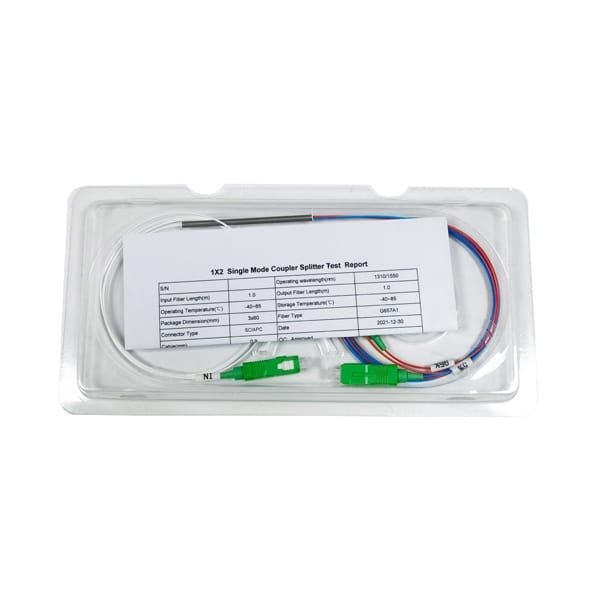
The key difference compared to splitter in GPON networks
| Comparison Dimensions | Splitters in OTN (Optical Transport Network) | Splitters in PON (Passive Optical Network) |
| Core Purpose | Monitoring, protection, and management | For service signal distribution and coverage |
| Network Location | Backbone/metropolitan core layer (located between two OTN devices, or within a device) | Access layer (located between the OLT and numerous ONUs) |
| Splitting Ratio | Primarily uses non-uniform splitting (e.g., 95:5), resulting in very low output optical power | Primarily uses uniform splitting (e.g., 1:32, 1:64), where power is evenly distributed. |
| Technical Requirements | Features low insertion loss, high stability, and a wide wavelength range, with certain requirements for polarization sensitivity | High uniformity, low cost, and strong environmental adaptability |
| Packaging Form | Often integrated into equipment subracks, or uses miniaturized, highly stable micro-packaging | Mostly available in lgx cassette, ABS box, or rack-mounted plc box types, used in outdoor optical distribution boxes or equipment room ODFs. |
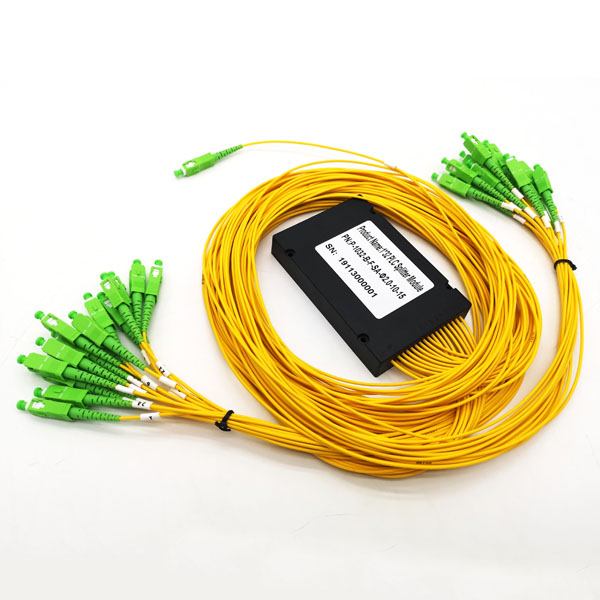
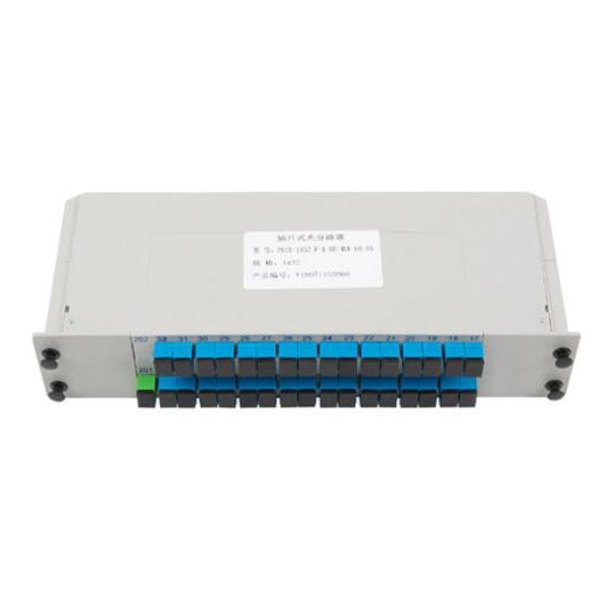

Key considerations for selection and application in OTN (Optical Transport Network)
- Insertion Loss is the primary indicator: OTN link budgets are very tight, especially in long-distance, high-speed (such as 400G) systems, so the additional loss introduced by the PLC fiber splitter must be minimized.
- Wavelength Flatness: Stable splitting ratio and low insertion loss must be maintained across the entire C/L band (1530nm-1625nm) to accommodate DWDM multi-wavelength systems.
- High Reliability and Stability: PLC fiber splitters used in protection switching scenarios must meet telecommunications-grade reliability standards (such as GR-1209-CORE) to ensure years of trouble-free operation.
- Directivity and Return Loss: Extremely low back reflection is required to prevent interference with laser operation.
✅ Conclusion
Optical fiber PLC splitters are important supporting components in high-speed, high-capacity OTN systems. Although they don’t perform the core splitting function as they do in PONs, they play an indispensable role in real-time network performance monitoring, link protection, and operation and maintenance diagnostics. When designing the optical layer of an OTN system, it is crucial to carefully select specific splitters with low insertion loss and high reliability based on the specific monitoring or protection requirements.
