 Skip to content
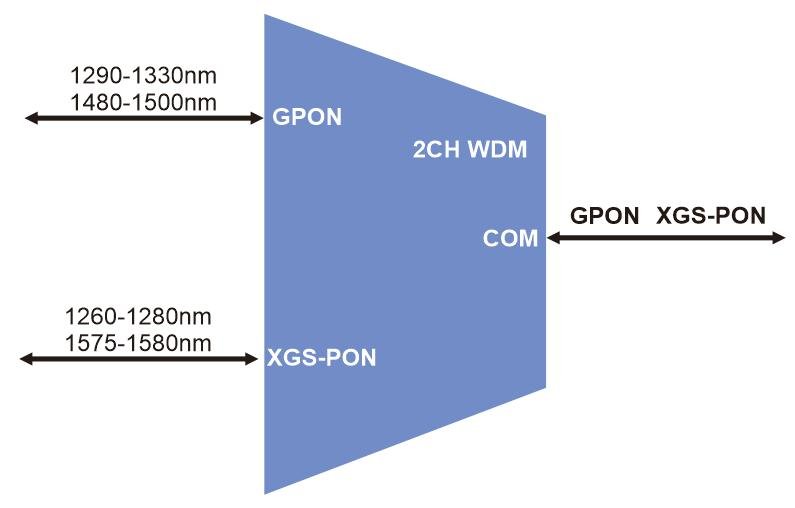
Combining GPON and XGS-PON is currently the mainstream solution for operators upgrading 10 Gigabit networks, mainly achieved through WDM1r (wavelength demultiplexer) technology. Because their wavelengths do not overlap at all, they can transmit signals on the same optical fiber without interference, much like creating different lanes on a highway.

Two main methods for achieving integration
1. Combo PON Solution (Built-in WDM)
This is currently the most popular integration method. It integrates the GPON and XGS-PON optical modules and the WDM combiner into a single Combo optical module.
- Working Principle: A mixed optical signal containing four wavelengths is directly emitted from a single port on the OLT (equipment room side).
- Advantages: Saves equipment room space, eliminates the need for external equipment, and reduces optical power loss (typically more than 1.5dB lower than external solutions).
- Compatibility: Supports simultaneous connection of GPON ONU and XGS-PON ONU to the same PON port.
2. External WDM1r Solution (External Combiner)
If your existing equipment does not support a Combo module, you can use a standalone WDM1r coexistence element (CEx).
- Working Principle: Insert the optical patch cords of the GPON OLT and XGS-PON OLT into the two input ports of the WDM1r device respectively. After combining, the output is sent to the existing splitter network through a common port (COM port).
- Advantages: High flexibility; can combine OLT equipment from different manufacturers.
- Disadvantages: Increases insertion loss and makes wiring relatively complex.

The Combined Four-Wavelength Operation Mechanism
Within a single optical fiber, the four wavelengths each perform their specific functions:
- Downlink: 1490nm (GPON) and 1577nm (XGS-PON) are mixed for downlink. The optical modem (ONU) in the user’s home has an internal wavelength filter. The GPON modem only receives 1490nm, ignoring 1577nm; the XGS-PON modem does the opposite.
- Uplink: 1310nm (GPON) and 1270nm (XGS-PON) are mixed for uplink. The WDM devices at the OLT end distribute the signal to their respective processing channels based on the wavelength.
Deployment Recommendations
- For new deployments: We strongly recommend using OLT boards that support Combo PON. This is the most efficient upgrade path advocated by mainstream manufacturers such as ZTE and Huawei.
- Optical Power Budget: After introducing WDM or Combo modules, link loss needs to be recalculated. The power budget level of XGS-PON (e.g., N1/N2/E1) is usually slightly higher than that of GPON to offset the attenuation caused by wavelength combining.
Do you want to understand the specific operational steps for upgrading an existing network, or do you want to know the optical power loss calculations under different solutions?
