Skip to content
Currently, there are two main types of passive fiber splitter on the market: fused biconical taper splitter and planar lightwave circuit splitter. For detailed information on their working principles, structure, product types, manufacturing process, packaging information, and the differences between the two, please refer to the following article:
FO Splitter Difference: FBT vs PLC Splitter
Although both types of FO splitters can achieve balanced and unbalanced distribution of optical signals, there are significant differences in their specific applications. Yingda has summarized all possible differences in the table below:
| Item | FBT Optical Coupler | PLC Optical Splitter Fiber |
| Supported splitting ratio | ≤1×8 (typically 1×2, 1×4) | 1×2 to 1×128 (mainstream options: 1×16, 1×32, 1×64) |
| Insertion loss | High (approximately 3.5–5.5 dB, increases significantly with increasing splitting ratio, can reach over 5.5 dB at 1×8, with large fluctuations) | Low and uniform (≤17 dB, typical value ≤16.5 dB for 1×64, port variation <0.5 dB) |
| Temperature stability | Poor, easily affected by high temperature and high humidity environments (loss fluctuation >1.0 dB in the range of -5℃~70℃) | Excellent (-40℃~85℃ operating temperature range with <0.5 dB variation, suitable for outdoor cabinets and environments without air conditioning) |
| Wavelength compatibility | Only supports specific wavelengths (e.g., 1310/1490 nm), requires additional filtering for 1577 nm/1270 nm, easily causes crosstalk | Full-band support (1260–1650nm), naturally supports 1270nm/1577nm upstream and downstream wavelengths without filtering |
| Cost | Low (suitable for budget-sensitive end deployments) | Medium to high cost (high initial investment, but low long-term operating costs) |
| Support for mixed access | Not recommended (wavelength sensitive, easily interferes with GPON/XG-PON coexistence) | Recommended (supports GPON, XG-PON, and XGS-PON coexistence, compliant with ITU-T G.987 standard) |
| Packaging type | Usually mini steel tube or box type, small size but weak protection | Diverse options: Mini steel tube type, ABS box type, rack-mounted type, LGX plug-in type, wall-mounted type, etc., suitable for all FTTH scenarios |
| Typical application scenarios | Secondary splitting, ≤4 end users, indoor temperature-controlled environment | Primary splitting, FTTH backbone, carrier-grade deployment, high-density residential areas, outdoor cabinets |
| Future evolution compatibility | Not supported, will become a bottleneck for network upgrades | Supports NG-PON2 multi-wavelength overlay without hardware replacement |
Deployment Scenario Selection Strategy Of FO Splitter
High-density urban FTTH network (e.g., residential areas in Shenzhen)
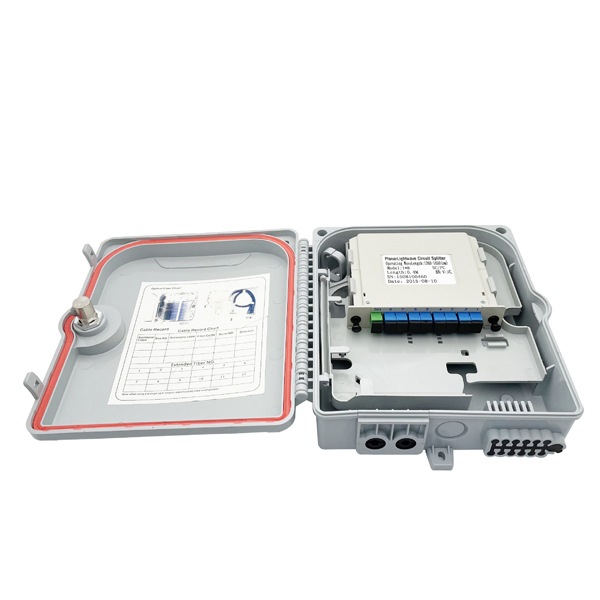
→ Primary splitting: Use 1×32 or 1×64 PLC splitters, centrally deployed in the optical distribution frame or cross cabinet to reduce the amount of trunk fiber required.

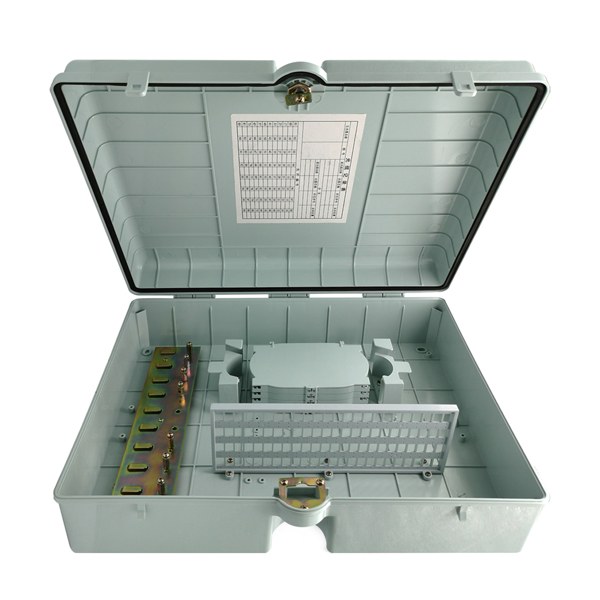
→Secondary splitting: If cascading is needed, the first stage uses a fiber PLC (1×8), and the last stage can also use a fiber PLC (1×8), ensuring a total splitting ratio of ≤1×64 to keep port loss controllable.

Rural or low-density areas:
→ 1×4 FBT optical splitter can be used as a terminal splitter at the discretion of the installer, but it must be installed in an indoor, temperature-controlled environment and must not be used in the main trunk link.


Hybrid access network (GPON + XG-PON + XGS-PON coexistence):
→ PLC splitters must be used. Their full-band characteristics ensure that the signals of different generations of ONUs do not interfere with each other, complying with the operator’s “smooth evolution” specifications.
Engineering Specifications and Future Compatibility
During engineering construction and design, we must strictly adhere to the following standards for deployment and link testing to ensure fast and stable network access and future compatibility.
- Standard Basis: Strictly adheres to ITU-T G.987, ensure FO splitter compliance with the specifications including insertion loss, return loss, and polarization-dependent loss (PDL ≤ 0.5dB).
- Evolution Capability: The fiber PLC splitter supports future NG-PON2 40G+ multi-wavelength overlay without requiring replacement of ODN hardware, protecting investment.
- Testing Recommendations: After deployment, end-to-end insertion loss verification should be performed using a stable light source and optical power meter to ensure a link budget margin of ≥3dB.
Conclusion
For XGPON and XGS-PON networks, Planar Lightwave Circuit splitters must be prioritized. The fiber PLC full-band compatibility (1260–1650nm), high uniformity, and strong environmental adaptability fully meet the engineering requirements of the ITU-T G.987 standard for XG-PON/XGS-PON.
Fused Biconical Taper FBT optical couplers are only permitted in end-user scenarios with very low splitting ratios (≤1×4) and stable temperature control, and are prohibited for use in trunk or primary splitting to avoid signal degradation due to temperature drift.
✅For cities with characteristics such as high temperature and humidity climates or high-density residential areas, all newly built or upgraded XGS-PON networks must uniformly adopt fiber PLC splitters, and the use of optical couplers is prohibited. It is also recommended to use Yingda’s ABS box plc splitter or LGX box plc splitter products to ensure long-term stable operation.