 Skip to content
Since 100G cabling systems are typically based on MPO-12 and MPO-8 structures, the method for integrating a 400G system into an existing 100G cabling infrastructure varies depending on the specific type of equipment interface. Yingda recommend the following approaches for this upgrade, wish it help you in some way.
If the 400G device features an MPO-16 interface
The primary challenges encountered when connecting it to an existing 100G cabling system are physical interface mismatches and discrepancies in channel data rates.
Solution 1: MTP 16 Breakout Cable
Due to 100G cabling infrastructure is based on MPO-12 or MPO-8 trunks, so you can splits a single 400G (MPO-16) interface into two standard 8-fiber MPO links by a MTP 16 cable. It is suitable for connecting a 400G switch to two existing 100G/200G cable links. This method is currently the most cost-effective upgrade solution because it allows for the utilization of existing backbone fiber cabling, no need for rewiring.
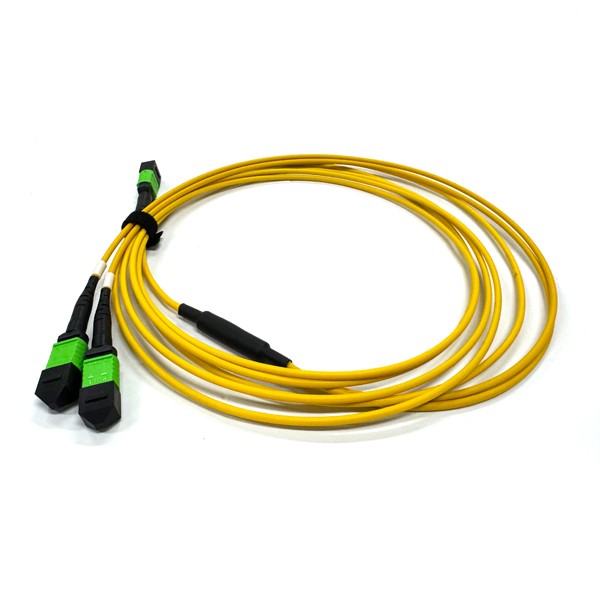
For more information, please refer to “Where are MPO 16 core to MPO 8 core patch cords primarily used? ”
Solution 2: MTP Fanout Cable
If you need to directly connect a 400G port to multiple 100G devices (such as 100g qsfp28 optical transceiver), you will need to use a MTP fanout cable for example fiber cable 400G to 2x 200G (or 4x 100G). This configuration splits a high-density port across multiple lower-speed devices using a 16-fiber to multi 8-fiber breakout cables. Yingda suggest below 3 types of cable which can make this happen:


If the 400G device features an MPO-12 interface
In this situation, it is 400G DR4 module with MPO-12 interface, there are two methods for your reference:
Solution 1: 400G DR4 to 4x 100G DR1 — use MPO 12 to 4x LC Duplex cable to connecting the 100G system.
A 400G DR4 module (typically featuring an MPO-12 interface) can be connected to four 100G DR1 modules (which incorporate internal DSPs) , which is capable of transmitting data at a 100G rate (equivalent to QSFP56), rather than 25G (QSFP28).
NOTE:
- MPO 12 to 4x LC Duplex cable must use MPO 12 APC connector, not UPC connectors, with 4 fibers in the middle not use. LC is blue connector UPC polishing.
- Since 400G utilizes eight 50G PAM4 lanes, it is mandatory to use 100G DR1 PAM4 modules; CWDM4 and LR4 modules cannot be used (as these two employ a 4x25G NRZ signal modulation scheme, which is incompatible with 400G, preventing data connectivity).

Solution 2: Port Backward Compatibility mode — use MTP MTP 12 cable directly.
Since most 400G switches (specifically those featuring QSFP-DD ports) are hardware-compatible with lower speeds and given that 400G DR4 modules typically utilize an MPO-12 interface, you can directly insert your existing 100G QSFP28 optical modules into the 400G QSFP-DD ports. In this scenario, you can simply continue using your existing 100G MTP 12 Cable; however, the bandwidth of the port will be limited to 100G.
NOTE:
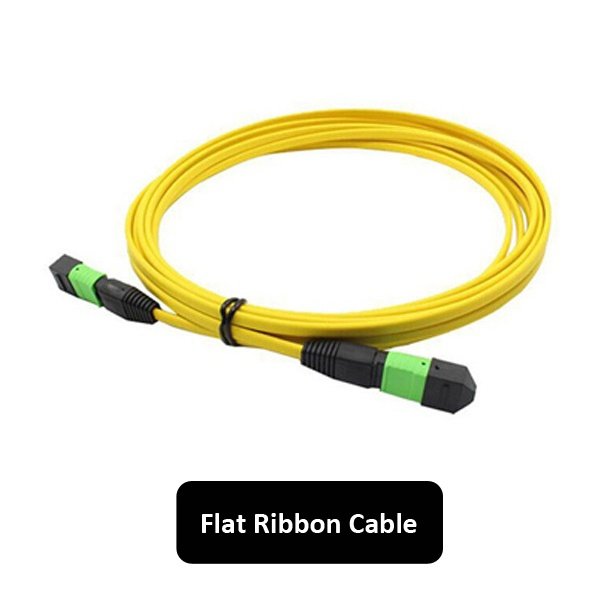
MPO 12 APC to MPO 12 APC patch cord use only the central 8 fibers, with the two fibers on each side left unused)
Conclusion
Based on the above analysis, we can conclude that when connecting 400G equipment to an existing 100G cabling system, the following key issues require particular attention:
- Physical Incompatibility: Note that the MPO 16 connector features an offset key; it is physically impossible to insert it into an MPO 12 adapter. Specialized conversion media must be used during the upgrade process.
- Polarity Matching: For upgrade scenarios, Type B (Cross-over) polarity is recommended to ensure that the transmitter (Tx) correctly aligns with the receiver (Rx).
- Module Compatibility: Ensure that your 400G modules support “Breakout” mode. For example, the 400G-DR4 inherently supports splitting, whereas certain single-lane modules do not.
Is your current 100G cabling system single-mode or multimode? This determines which specific model of MPO conversion cable you need to select.
