 Skip to content
In daily procurement, you may know that yellow sheath represents single mode cable, and orange, aquamarine, and purple sheath represent multimode cable. Do you know the color of the fiber coating inside? Many people are probably not, making it even more confusing when purchasing optical cables or multi-core patch cords. Below, we’ll provide a simple explanation for you.
Currently, the colors of the optical fibers and fiber loose tube sheaths inside low-voltage engineering cables are generally identified using a full color spectrum. Natural colors ( also called original) are permitted as long as they do not affect identification. Generally, the chromatographic arrangement of the tubes within an optical fiber and the chromatographic arrangement of the optical fiber within a tube are as follows:
Chromatographic Arrangement of Fiber in a Loose Tube
It is International Fiber Chromatography, applicable to ordinary patch cords, pigtails, and indoor optical cables.
| Fiber number | 1 | 2 | 3 | 4 | 5 | 6 | 7 | 8 | 9 | 10 | 11 | 12 |
| Fiber code | Blue | Orange | Green | Brown | Gray | White | Red | Black | Yellow | Purple | Pink | Cyan |
Note:
- When there are fewer than 12 fibers in the loose tube, the chromatogram should be taken continuously starting from number 1.
- In the standard chromatogram, the white color at number 6 can be replaced by a natural color, referred to as standard chromatogram W.


12 Strands LC UPC Pigtails 1.5 Mts
12 Colors: blue, orange, blue, brown, gray, white, red, black, yellow, violet, pink, cyan
Loose tube color scheme arrangement in stranded optical cables
it is suitable for multi-core outdoor cables.
| Color Scheme: Tube number and color | ||||||||||||
| Tube number | 1 | 2 | 3 | 4 | 5 | 6 | 7 | 8 | 9 | 10 | 11 | 12 |
| Tube color | Red | Green | Natural | Natural | Natural | Natural | Natural | Natural | Natural | Natural | Natural | Natural |
- When the cable core contains filler rope, the filler rope is arranged close to the red tube, unless otherwise specified.
- When the cable core contains only one tube, that tube is generally green, unless otherwise specified.

Ribbon Fiber with Color-coded Markings
BELLCORE’s international core sequence is: Blue, Orange, Green, Brown, Gray, White, Red, Black, Yellow, Purple, Pink, Cyan; (Orange is also called Tangerine).
The color code must conform to the Munsell color standard, which is the most comprehensively implemented color code arrangement globally.
International full color spectrum: Blue, Orange, Green, Brown, White, Red, Black, Yellow, Purple, Pink, Cyan. The loose tube sequence is the same.
| Full Chromatography | ||||||||||||
| Tube number | 1 | 2 | 3 | 4 | 5 | 6 | 7 | 8 | 9 | 10 | 11 | 12 |
| Tube code | Blue | Orange | Green | Brown | Gray | White | Red | Black | Yellow | Purple | Pink | Cyan |
The PLC splitters and corresponding fiber array (FAs) provided by YINGDA are all made from ribbon fibers, not individual optical fibers. Therefore, the fiber coloring follows the pattern described above.
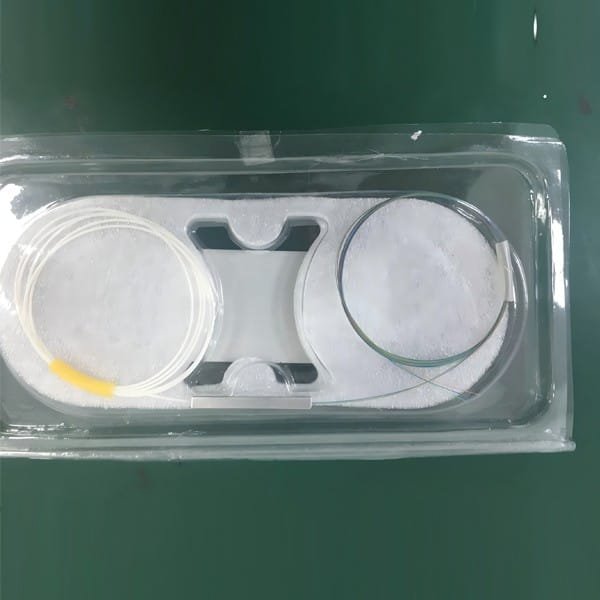


Input: Original
Output: 2*8 Color (Blue/Orange/Green/Brown/Gray/White/Red/Black)
If the number of optical fibers in a cable exceeds 12, how are they colored?
When the number of optical fibers in a loose tube exceeds 12, the fiber colors are generally arranged according to the cable’s linear sequence color, using black dots or stripes to distinguish them. For example, for a 24-core cable, more black dots are added to the outer sheath of cores 13-24 to differentiate them, while the fiber colors remain in the 12-color sequence.
| 24-core Fiber Optic Cable With Chromatographic Markings | ||||||||||||
| Fiber number | 1 | 2 | 3 | 4 | 5 | 6 | 7 | 8 | 9 | 10 | 11 | 12 |
| Fiber color | Blue | Orange | Green | Brown | Gray | White | Red | Black | Yellow | Purple | Roes red | Sky blue |
| Fiber number | 13 | 14 | 15 | 16 | 17 | 18 | 19 | 20 | 21 | 22 | 23 | 24 |
| Fiber color | Blue | Orange | Green | Brown | Gray | White | Red | Black | Yellow | Purple | Roes red | Sky blue |


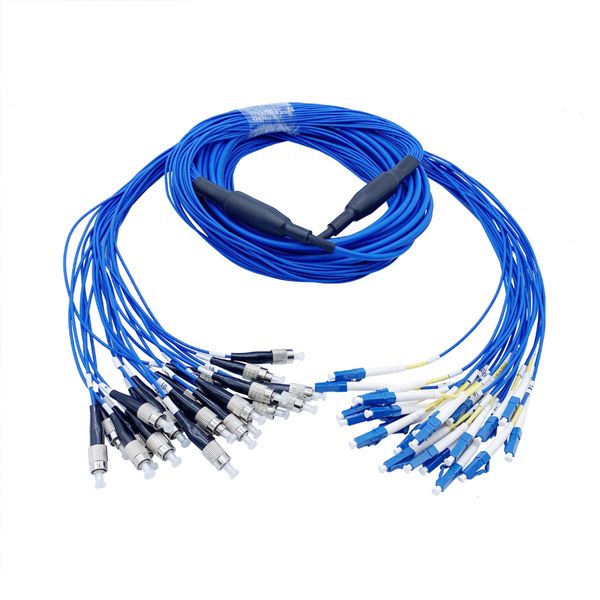
Multi-core cables are commonly used outdoors. The fiber optic color sequence (1#-12#) typically consists of blue, orange, green, brown, gray, white, red, black, yellow, purple, pink, and light green. If the fiber diameter (12D) is less than 12D, it can be contained in a single bundle tube, also called a central bundle tube type.
If the fiber diameter (12D) is required, two or more bundle tubes must be used. The bundle tubes are generally red, followed by green, then white 1, white 2, white 3, and so on. For 144D, 12 bundle tubes are used, each with a 12D diameter. This type of cable, made by twisting multiple bundle tubes together, is also called a stranded optical cable.
Some manufacturers also use ribbon fiber, with 12 fibers arranged in a row as a group, with the same color sequence.
The sequence should be red head and green tail, inside to outside, fusing larger core counts first, then smaller core counts…
Currently, domestically produced bundled optical fibers can only reach 288 cores. Generally, manufacturers arrange the fibers from the first layer outwards. Any higher core count can only result in a ribbon-like fiber. The international core sequence is: blue, orange, green, brown, gray, white, red, black, yellow, purple, pink, cyan, and natural color; the loose tube sequence starts with red and ends with white.
